
It's Monday morning. The weekly kickoff. Eight people around the table, coffee in hand, laptops open. The entrepreneur starts: "Where do we stand?"
What follows is a half hour that feels like an hour. Everyone talks. Nobody truly listens. The project manager explains the proposal didn't go out because he was waiting on input from sales. Sales says they thought marketing was handling it. Marketing looks up, confused. "What proposal?"
The entrepreneur feels the familiar knot in his stomach. He had this exact conversation last week. And the week before. Different proposal, different project, same problem.
After the meeting, he walks to his office. On his desk are three things that shouldn't be his: a customer complaint that was "quickly" forwarded to him, an invoice nobody had checked, and a CV for a vacancy he didn't even know was open.
He sighs. Not out of frustration with his people. Out of frustration with himself. Because somewhere, deep down, he knows. This isn't a case of bad employees. This is a case of a business that grew without anyone ever clearly defining who does what.
And so everyone does everything. And nobody does enough.
The problem hiding behind good intentions
Let's be honest: in most SMEs, roles, tasks and responsibilities have grown organically. And that makes sense. In the beginning, the team was small. Everyone did whatever was needed. The entrepreneur was salesperson, bookkeeper, customer service and caretaker all at once. And it worked. Because everyone saw everything, knew everyone, and understood what needed to happen.
But then the business grew.
People were added. First one, then three, then ten. And every time, someone was hired for "a bit of everything." Job titles were vague. Tasks were distributed based on whoever happened to have time. Responsibilities? Those belonged to everyone — which meant they belonged to no one.
The strange thing is: it doesn't feel like a problem. It feels like flexibility. Like team spirit. Like "we're not corporate, we just roll up our sleeves."
Until it starts to crack.
Three symptoms you recognise (but misdiagnose)
1. "Everything ends up on my plate"
The entrepreneur who gets everything dumped on his desk often thinks he needs to learn to delegate. And yes, that's partly true. But delegation only works if there's someone to delegate to. Someone with a clear mandate, a defined responsibility, and the authority to act.
Without that structure, delegation is just passing the parcel. And passing the parcel always ends up in the same place: back with you.
The problem isn't that you won't let go. The problem is there's nothing to let go into.
2. "Things fall through the cracks"
That project nobody picked up. That customer who was called back too late. That invoice that sat untouched for three weeks. Not because people are lazy. But because genuinely nobody knew it was their job.
In a business without clear task allocation, grey areas emerge. Zones where everyone assumes someone else is handling it. And in those grey areas, things disappear. Not with a bang, but with a whisper. Slowly. Invisibly. Until a customer calls and asks: "Where's my order?"
3. "My people don't take initiative"
This might be the most painful misconception. The entrepreneur who complains that his team isn't proactive rarely realises he's the cause. Not because of what he does, but because of what he hasn't done: made it clear who is responsible for what.
People don't take initiative when they don't know where their territory begins and ends. They don't make decisions when they don't know if they're allowed to. They don't step forward when they're afraid of stepping on someone else's toes.
For an employee, ambiguity doesn't feel like freedom. It feels like a minefield.
What's actually needed (and it's less than you think)
The good news? This doesn't have to be a months-long reorganisation project. No thick manuals, no consultants with PowerPoints. It starts with three simple but confronting questions.
It starts with three simple but confronting questions.
Question 1: Who is responsible for what?
Not "who usually does this" or "who could probably do this." But: who owns it? One name per responsibility. No pairs, no "the team." One person you can hold accountable. Who has the mandate. Who knows: this is mine.
Sounds rigid? It's liberating. For you and for your team.
Question 2: Which tasks belong to which role?
Write it down. Not as a bureaucratic document, but as a clear overview. What does the sales manager do? What does the operations manager do? Where does one role begin and the other end?
You'll discover overlap. Gaps. Tasks that belong to nobody. Tasks that belong to three people. That's where the chaos lives. And once you see it, you can fix it.
Question 3: Which authority comes with which responsibility?
This is the step most entrepreneurs skip — and it's the most important one. Responsibility without authority is an empty shell. If you make someone responsible for customer satisfaction but they're not allowed to resolve a complaint independently, you haven't appointed a responsible person. You've created a forwarding address.
Don't just give people a task. Give them the space to truly carry it out.
Structure isn't bureaucracy.... it's oxygen
There's a persistent fear among entrepreneurs: if I add too much structure, I'll lose the flexibility that made us successful. It'll become rigid. Corporate. Dull.
The opposite is true.
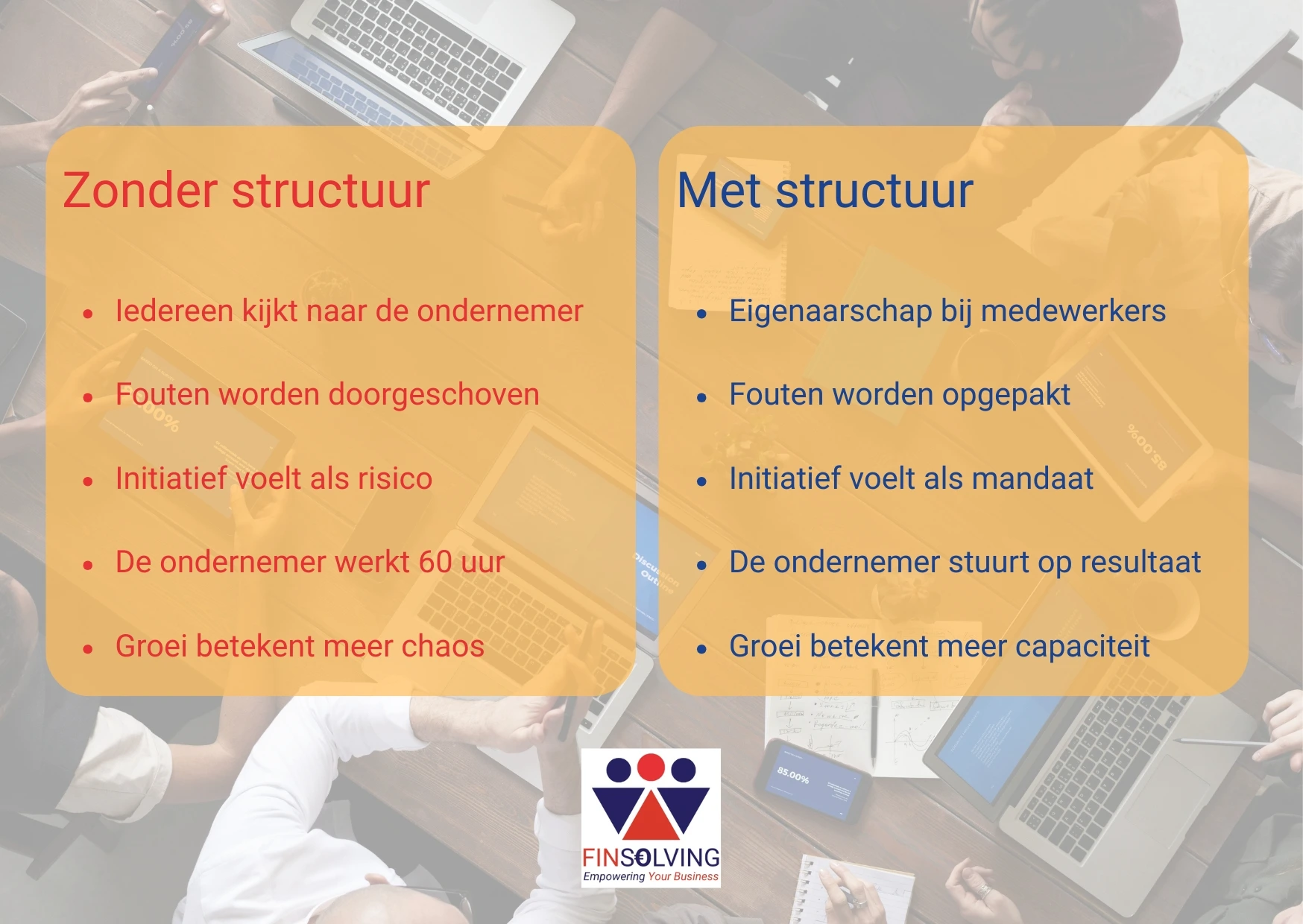
Structure in roles, tasks and responsibilities doesn't give your team limitations. It gives them clarity. And clarity is the fastest path to ownership, initiative and peace of mind.
Back to Monday morning
Imagine the weekly kickoff going differently. The project manager doesn't wait on sales because he knows the proposal is his responsibility. Sales doesn't point at marketing because the task division is clearly documented. The entrepreneur doesn't find a complaint on his desk because the service lead has the mandate to resolve it herself.
Imagine that Monday morning, the entrepreneur doesn't sigh but listens. Doesn't intervene but steers. Isn't the busiest person in the room, but the calmest.
That's what happens when roles, tasks and responsibilities are no longer accidental but intentional. It's the moment your internal organisation stops leaking and starts performing.
Not because your people work harder. But because they finally know what they're working on.
Does this sound familiar? Get in touch. You don't have to figure it out alone.